



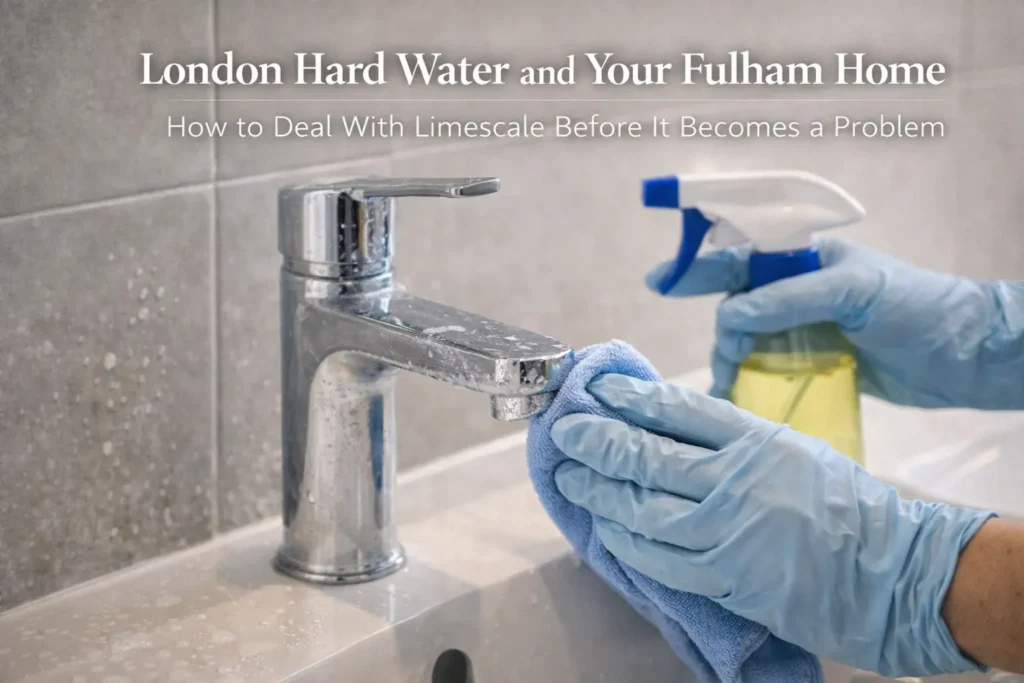




If you have moved to Fulham from another part of the UK or from outside England, you will have noticed it within weeks: a white, chalky residue appearing around your taps, on your shower glass, and at the base of your kettle. This is limescale — and in Fulham, you are dealing with some of the hardest water in the country.
Left untreated, limescale causes real damage: it reduces water pressure in shower heads, causes taps to drip, accelerates appliance wear, etches shower glass permanently, and is one of the most common causes of deposit deductions in Fulham rental properties. This guide explains what causes it, how to remove it at different stages, and how to prevent it building up faster than you can deal with it.
Why London Water Is So Hard
Water hardness is measured in milligrams of calcium carbonate per litre (mg/l CaCO₃). Water below 60 mg/l is soft; water above 200 mg/l is classified as very hard. London’s water typically measures 250–320 mg/l — significantly harder than the national average of around 143 mg/l.
This happens because London’s water supply comes primarily from chalk and limestone aquifers. As rain water travels through these rock formations, it dissolves calcium and magnesium salts. When hard water is heated or evaporates, those salts are deposited as the white calcium carbonate residue you see on surfaces.
| 📊 | In Numbers
Fulham and the SW6 postcode receives water with calcium hardness approximately twice the UK national average. A shower head used daily in a Fulham property can accumulate visible limescale within 2–3 weeks without treatment. |
Where Limescale Builds Up in a Fulham Home
| Location | Build-Up Speed | Consequence if Untreated |
| Shower head | 2–3 weeks visible | Reduced water pressure, uneven spray, blocked nozzles |
| Shower glass | 1–2 weeks visible | Permanent etching if left more than 3–6 months |
| Bath and basin taps | 2–4 weeks visible | Dripping, reduced flow, eventual mechanism failure |
| Kettle | 1–2 weeks visible | Particles in drinks, reduced boiling efficiency |
| Washing machine | Months to notice | Reduced heating efficiency, pump damage over time |
| Dishwasher | Months to notice | Cloudy glasses, reduced cleaning performance |
| Toilet waterline | 4–6 weeks visible | Brown-yellow ring that becomes very difficult to remove |
| Heating element (boiler) | Years | Reduced efficiency, increased energy bills, early failure |
How to Remove Limescale: By Severity
Light build-up (up to 4 weeks)
White vinegar is your most effective and accessible tool for light limescale. The acetic acid dissolves calcium carbonate without damaging most bathroom surfaces.
For taps and fixtures:
- Soak a cloth in undiluted white vinegar.
- Wrap it around the affected fixture and leave for 30–60 minutes.
- Wipe clean with a damp cloth. Buff dry to prevent water spots.
For shower heads:
- Fill a plastic bag with white vinegar.
- Secure it around the shower head with an elastic band so the head is submerged.
- Leave for 1–2 hours, or overnight for stubborn build-up.
- Remove, run the shower briefly to flush, and wipe the head clean.
Moderate build-up (1–3 months)
For more established limescale, white vinegar alone may be insufficient. Commercial descalers such as HG Extra Strong Lime Scale Remover, Viakal, or Ecozone Limescale Remover are significantly more effective on thicker deposits.
- Apply the descaler to the affected area according to the product instructions
- Leave for the recommended contact time — typically 3–5 minutes for moderate build-up
- Agitate with a non-scratch pad or old toothbrush for stubborn areas
- Rinse thoroughly — always rinse completely, as descaler left on chrome can cause damage
- Repeat if needed — one application rarely removes months of build-up completely
Heavy build-up (3+ months, or neglected properties)
Heavy limescale — particularly on shower glass, around the base of taps, and in toilet bowls — requires extended contact time, specialist products, and sometimes mechanical action.
| ⚠️ | Shower Glass Warning
Once limescale has etched into shower glass, it cannot be removed by descaling. The calcium carbonate has chemically bonded with the glass. Prevention is the only solution — once etching has occurred, polishing compounds or glass replacement are the only options. |
Room-by-Room Descaling Schedule for Fulham Properties
| Area | Recommended Frequency | Method |
| Shower head | Every 2–3 weeks | Vinegar soak |
| Shower glass | Every 1–2 weeks | Squeegee after each use + weekly spray |
| Bath and basin taps | Every 2–4 weeks | Vinegar cloth wrap |
| Toilet (waterline) | Monthly | Commercial toilet descaler, leave overnight |
| Kettle | Every 2–3 weeks | Descaling tablet or vinegar solution, boil and rinse |
| Washing machine | Monthly | Descaling tablet on empty 60° cycle |
| Dishwasher | Monthly | Dishwasher cleaner tablet on empty cycle |
Prevention: The Faster and Cheaper Approach
Daily habits that make a real difference:
- Squeegee shower glass after every use — removes water droplets before they dry and deposit calcium
- Wipe taps dry after use — particularly around the base where water collects
- Run the cold tap briefly after using hot water — reduces scale build-up in the outlet
Product solutions:
- Limescale-preventing shower spray — spray on glass after each use to prevent adhesion
- Water softener sachets for washing machine and dishwasher — reduces scale build-up on heating elements
- Shower head filter attachment — reduces the hardness of water hitting the shower head
Whole-property solution:
A whole-house water softener eliminates hard water at source. Installation costs £800–£1,500, but completely prevents limescale build-up on all fixtures and extends appliance life significantly. For homeowners in Fulham, particularly those with high-specification bathrooms, the long-term cost saving is substantial.
Limescale and Your Tenancy Deposit
Limescale is one of the most consistent causes of deposit deductions in Fulham rental properties. Here is what tenants need to know:
- Letting agents specifically check shower glass, taps, and shower heads at checkout
- Heavy limescale on taps and shower heads is usually classed as inadequate cleaning — not fair wear and tear
- Etched shower glass may be charged as damage, not just cleaning, if severe
- A professional descale as part of an end of tenancy clean is significantly more effective than DIY — professional-grade products and techniques achieve better results on heavy build-up
| 💡 | Practical Advice
Start the descaling process at least a week before checkout, not the night before. Multiple applications over several days are more effective on established limescale than a single intensive treatment. |
Professional Descaling as Part of a Deep Clean or End of Tenancy
At Maid in Fulham, all deep cleans and end of tenancy cleans include full bathroom and kitchen descaling using professional-grade products. This is one of the most visible differences between a professional clean and a DIY clean in a London property — the results on limescale in particular are substantially better with commercial-strength descalers and the right technique.